
Braised Duck - Teochew style


Based on this recipe:
http://ieatishootipost.sg/teochew-braised-duck-recipe/

The simplest recipe that I found:
1 Duck
Cinnamon sticks 5
Dried chillies 2
Star anise 5
Blue ginger (galangal) 7 slices
Garlic 7 cloves
Dark Soy Sauce 350ml
2 Tbsp white sugar


I marinated the 2kg duck with some salt for a whole day in the fridge, more out of timing necessity than anything else. Then, blanched the duck with hot boiling water twice. In case the gamey smell would be too strong. Actually, this turned out to be unfounded, just as written in the blog - Mr Teo, the head chef who gave the recipe didn't do any other prep except to put the duck into the sauce. This is because after about 45mins to an hour of braising, the sauce and duck smell had melded into a fragrant mix, not gamey at all. It smelt of galangal, cinnamon and star anise.


I also added a piece of dried mandarin orange peel and little piece of old ginger. But these flavours had disappeared in the mix.


First half hour of braising. Turning ...
The Tai Hwa superior dark soy sauce packaging is now 640ml. So, about half a bottle went into the wok and a lot of water. After the initial 2 bowls, I must have added 5-6 bowls more of water. Tasted the sauce but didn't adjust much - just a touch more of dark soya sauce and another teaspoon of sugar.

Almost ready ...

The duck was very soft after 1.5 hours of braising. Maybe it was ready after 1 hour. Should have checked the softness level earlier. Or reduced the flame to a slower braise. The duck wings disintegrated. The webbed feet were nice and soft, though. Overall, the taste of the soft duck was very good.
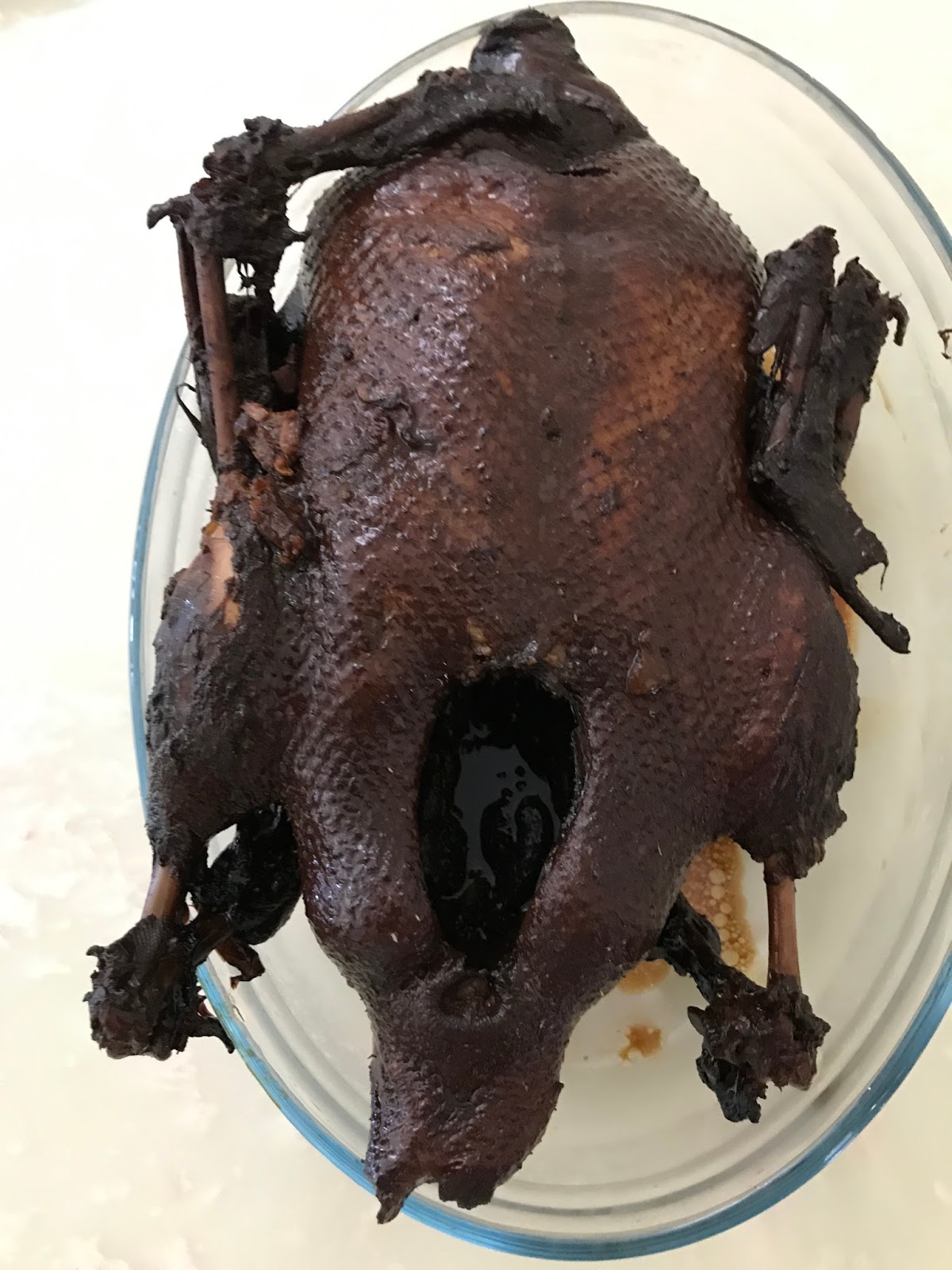
After 1.5 hours, the duck was very soft. Challenge to cut.
Put some of the duck gravy in a pot and added 2 pieces of tofu and 1 packet of tofu puffs. Slow flame for 15-20 mins. Didn't need to add anything else, all the flavour of the duck gravy was absorbed by the tofu.

Took the duck gravy to cook tofu & tofu puffs. And also flavour the yam rice.

The yam rice was intentionally made with less sauce than usual, in order to reduce the overall saltiness of the meal. There was plenty of duck gravy to add according to one's taste.


Comments

Popular posts from this blog

Farfalle

Made some farfalle - I was intrigued by the prettiness of the shape. It's hard work though, all for the sake of the jagged edges. I cleaned out my old craft scissors to do the cutting. Now I realised that the commercial pasta only has jagged edges on the ends of the 'bows'. Not the other side! Well, I may not make this again. The middle of the bow is thick, as expected. So, there's more 'bite' there! But the lemon sauce with cheese, spring onions, cherry tomatoes and lemon zest - that was really refreshing. Uneven sizes and thickness but they still look pretty. Simple lemon, olive oil sauce with some cheese.

The old writers

I first noticed these words in a novel. Only the first three lines as the writer was describing a fear and restlessness but not a seeking of the divine. I looked for them later and there they were, in the Service Book in church. Part of the Evening Prayer, it may seem out of sorts for us city dwellers with lights everywhere, all the time. But, the night is still there, darkness still in us. These writers of old, they write so well. Or maybe they just knew their God better. in your mercy defend us from all perils and dangers of this night

Okinawan Spinach

A friend gave me a cutting of Okinawan Spinach. Yay, new vegetable to try planting. The leaves can be eaten raw or cooked. https://en.wikipedia.org/wiki/Gynura_bicolor Gynura bicolor, hongfeng cai 紅鳳菜, okinawan spinach or edible gynura, is a member of the chrysanthemum family (Asteraceae). It is native to China, Thailand, and Myanmar but grown in many other places as a vegetable and as a medicinal herb. Since most of the leaves needed to be removed for the rooting, I made a salad. This was a 'Global' Salad with Okinawan Spinach, Mexican Asparagus, Malaysian cucumber and cherry tomatoes, Argentinian blue berries and NZ salad dressing! In future, if I grow this vegetable successfully, I will stir fry it with sesame oil and ginger. https://en.wikipedia.org/wiki/Gynura_bicolor   According to Chinese food grouping, Gynura bicolor is a 'cool' food, so the leaves are stir-fried with sesame oil and ginger (both 'hotter' foods) to achieve a balance. After m...